I've been writing Clojure codes and using Frederick Giasson's Emacs init file for almost a month. I find his init file gravitates towards simplicity and pragmatism. I've used other people's init file but end up disliking how my Emacs behaves. I would almost certainly blame the unnecessary packages for this.
I've copied Frederick's init file, excluded monokai-theme and turned off a few other settings. Below is the GitHub link: https://github.com/lyeung/dot-emacs
Showing posts with label clojure. Show all posts
Showing posts with label clojure. Show all posts
Tuesday, August 15, 2017

Tuesday, February 7, 2017
My First Macro
I'm writing my first test code to cover my HugSQL. I'm still on my training wheels, so I can't be more fancier here:
-- :name get-user-type :? :*
-- :doc get user by type
select id, name from users where type = :type order by id
Now comes the mythical test code. Let's suppose "db/add-user!" exists, performs database inserts into the users table and returns 1 as return value.
(deftest test-user
(jdbc/with-db-transaction [t-conn *db*]
(jdbc/db-set-rollback-only! t-conn)
(is (= 1 (db/add-user!
t-conn
{:username "u123"
:type "admin"})))
(is (= {:username "u123"
:type "admin"}
(db/get-user-type t-conn {:type "admin"}))))))
But alas! This is an epic failure!
(expected: {:username "u123",
:type "admin"}
actual: ({:id 1,
:username "u123",
:type "admin"})
(is (match-record {:username "u123"
:type "admin"}
(first result))))))
I know my macro is sub-optimal here and there are better ways of doing this. But hey! I'm certain my dear mother will be proud of me!
-- :name get-user-type :? :*
-- :doc get user by type
select id, name from users where type = :type order by id
Now comes the mythical test code. Let's suppose "db/add-user!" exists, performs database inserts into the users table and returns 1 as return value.
(deftest test-user
(jdbc/with-db-transaction [t-conn *db*]
(jdbc/db-set-rollback-only! t-conn)
(is (= 1 (db/add-user!
t-conn
{:username "u123"
:type "admin"})))
(is (= {:username "u123"
:type "admin"}
(db/get-user-type t-conn {:type "admin"}))))))
But alas! This is an epic failure!
(expected: {:username "u123",
:type "admin"}
actual: ({:id 1,
:username "u123",
:type "admin"})
It appears that ":id" value is an auto-generated primary key and this equality test is not going to work.
Perhaps, I could define a function to remove the id before comparing? This might work as the id is a surrogated key automatically populated by the database.
(defn match-record
[expected record]
(= expected (dissoc record :id)))
Or perhaps I could raise the bar higher by writing a macro? After all, I've heard Clojure macro is a powerful language extension.
(defmacro match-record
[expected record]
`(= ~expected (dissoc ~record :id)))
This is really exciting - my first ever Clojure macro!
So, rewriting my test code gives me,
(deftest test-user
(jdbc/with-db-transaction [t-conn *db*]
(jdbc/db-set-rollback-only! t-conn)
(is (= 1 (db/add-user!
t-conn
{:username "u123"
:type "admin"})))
(let [result (db/get-user-type t-conn {:type "admin"})](jdbc/with-db-transaction [t-conn *db*]
(jdbc/db-set-rollback-only! t-conn)
(is (= 1 (db/add-user!
t-conn
{:username "u123"
:type "admin"})))
(is (match-record {:username "u123"
:type "admin"}
(first result))))))
I know my macro is sub-optimal here and there are better ways of doing this. But hey! I'm certain my dear mother will be proud of me!
Saturday, November 26, 2016
Clojure Atom, Swap!, Reset! and Concurrency
I've encourage myself to keep writing simple Clojure codes. Obviously, this encouragement should extend beyond the traditional "Hello World!" program, shouldn't they?
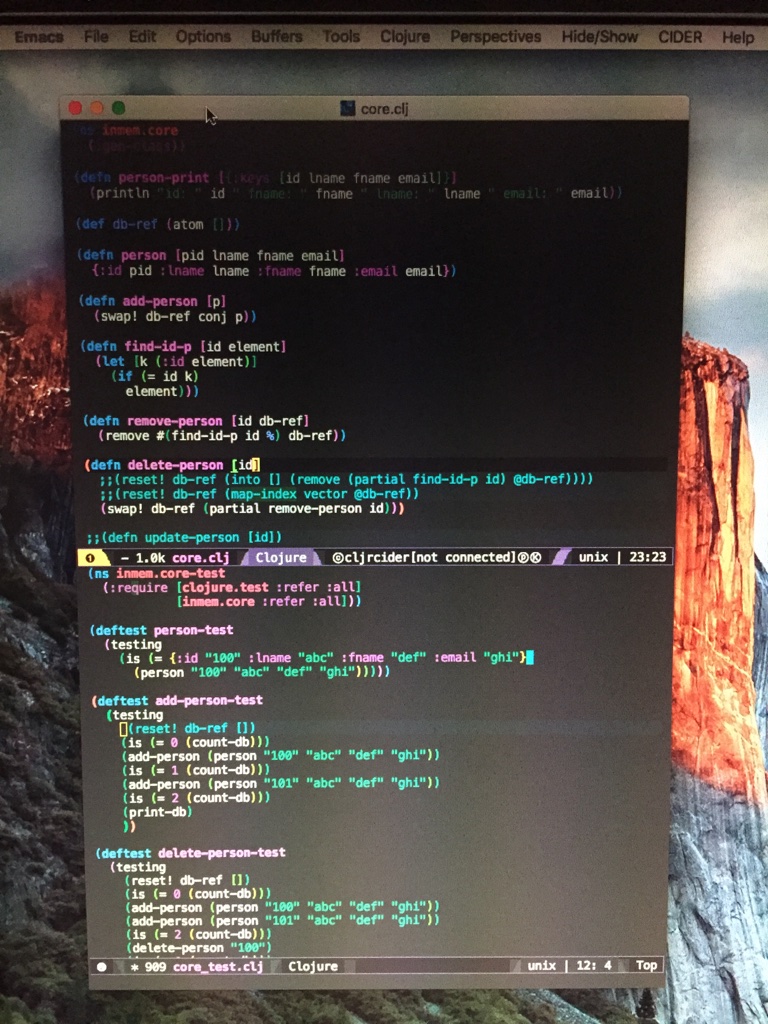
Recently, I've attempted to write a in-memory database program that keeps track of person record. This in-memory database is nothing but a list (in an abstract sense) and each element in the list contains a map of properties that describes a person.
So, we'll have a variable called "db-ref" bounded to an atom of Clojure vector:
We also need a function to create a person containing id, first name, last name and email :
(Does this remind you of a factory pattern?)
To add a person to the database
As you can see, we're adding the parameter "p" (for person) into db-ref using "swap!"
We also need a way to remove a person by their "id". All we have to do is use the same pattern as "add-person", but as oppose to conjoining, we use the remove function (how difficult could this be?):
Surely, our test code below should quickly tell us how awesome we are after the first attempt...
Running "lein test":
Oopsie! A big fat error telling us something is terribly wrong. Maybe we could sidestep the problem by using reset! function.
Recently, I've attempted to write a in-memory database program that keeps track of person record. This in-memory database is nothing but a list (in an abstract sense) and each element in the list contains a map of properties that describes a person.
So, we'll have a variable called "db-ref" bounded to an atom of Clojure vector:
(def db-ref (atom []))
We also need a function to create a person containing id, first name, last name and email :
(defn person [pid lname fname email]
{:id pid :lname lname :fname fname :email email})
(Does this remind you of a factory pattern?)
To add a person to the database
(defn add-person [p]
(swap! db-ref conj p))
As you can see, we're adding the parameter "p" (for person) into db-ref using "swap!"
We also need a way to remove a person by their "id". All we have to do is use the same pattern as "add-person", but as oppose to conjoining, we use the remove function (how difficult could this be?):
(defn find-id-p [id element]
(let [k (:id element)]
(if (= id k)
element)))
(defn delete-person [id]
(swap! db-ref (into [] (remove (partial find-id-p id) @db-ref))))
Surely, our test code below should quickly tell us how awesome we are after the first attempt...
(deftest delete-person-test
(testing
(is (= 0 (count-db)))
(add-person (person "100" "fred" "flintstone" "fred@flintstone"))
(add-person (person "101" "barney" "rubble" "barney@rubble"))
(is (= 2 (count-db)))
(delete-person "100")
(is (= 1 (count-db)))
(delete-person "101")
(is (= 0 (count-db)))))
Running "lein test":
ERROR in (delete-person-test) (APersistentVector.java:292)
Uncaught exception, not in assertion.
expected: nil
actual: java.lang.IllegalArgumentException: Key must be integer
at clojure.lang.APersistentVector.invoke (APersistentVector.java:292)
...
...
...
Oopsie! A big fat error telling us something is terribly wrong. Maybe we could sidestep the problem by using reset! function.
(defn delete-person [id]
(reset! db-ref (into [] (remove (partial find-id-p id) @db-ref))))
Re-running the test should tell us we could totally sidestep the issue.
0 failures, 0 errors.
But before we conclude, Clojure documentation says,
(reset! atom newval)
Sets the value of atom to newval without regard for the
current value. Returns newval.
Our in-memory database may not work correctly in concurrent environments.
Alright, let's try to revisit the problem. Afterall, we're awesome aren't we?
The swap! function documentation says:
(swap! atom f) (swap! atom f x) (swap! atom f x y)
(swap! atom f x y & args)
Atomically swaps the value of atom to be:
(apply f current-value-of-atom args). Note that f may be called
multiple times, and thus should be free of side effects.  Returns
the value that was swapped in.
It looks like we shouldn't dereference "db-ref" when calling on swap.
Below is another take to delete a person using the swap! function:
(defn remove-person [id db-ref]
(remove #(find-id-p id %) db-ref))
(defn delete-person [id]
(swap! db-ref (partial remove-person id)))
We added an extra helper function to call on the actual remove function.
Running the test displays:
0 failures, 0 errors.

Friday, October 28, 2016
Destructuring Clojure Vector and Map
Clojure documentation describes destructuring as:
So, what does this mean?
Suppose we have a vector that contains the bridge officers found in Star Trek original series:
To retrieve the values, we could destructure the elements this way:
What happened here was the keyword :kirk is bound to the variable a, :spock to b and so on and so forth.
Suppose we have a slightly different vector, where :sulu and :uhura belongs to another subvector:
To retrieve the values:
If we're not interested with Spock and Uhura, we replace the variables with underscore character "_":
Now, let's talk about destructuring a map.
Suppose we have a map that contains the rank and names of the crew:
To retrieve the values by the keys:
The variable a is bound to the value of the key :captain and b is bound to the value of the key :lt-cmd.
To complicate the map structure a bit, I'm going to add a few more members as an embedded map:
To retrieve the values including the embedded map:
As you can see, we need to use :non-bridge-officers as the key to refer to the embedded map.
Destructuring is a way to concisely bind names to the values inside a data structure. Destructuring allows us to write more concise and readable code.
So, what does this mean?
Suppose we have a vector that contains the bridge officers found in Star Trek original series:
(def star-trek-bridge-officers [ :kirk :spock :sulu :uhura ])
(let [[a b c d ] star-trek-bridge-officers]
println (str a " " b " " c " " d))
;; ":kirk :spock :sulu :uhura"
What happened here was the keyword :kirk is bound to the variable a, :spock to b and so on and so forth.
Suppose we have a slightly different vector, where :sulu and :uhura belongs to another subvector:
(def star-trek-bridge-officers-2 [ :kirk :spock [:sulu :uhura]])
To retrieve the values:
(let [[a b [c d]] star-trek-bridge-officers-2] println (str a " " b " " c " " d))
;; ":kirk :spock :sulu :uhura"
If we're not interested with Spock and Uhura, we replace the variables with underscore character "_":
(let [[a _ [c _]] star-trek-bridge-officers-2]
println (str a " " c))
;; ":kirk :sulu"
Jim, you can't risk your life on theory!
Now, let's talk about destructuring a map.
Suppose we have a map that contains the rank and names of the crew:
(def star-trek-crew { :captain "kirk" :lt-cmd "spock" :lt-1 "sulu" :lt-2 "uhura" })
(let [{a :captain b :lt-cmd c :lt-1 d :lt-2 } star-trek-bridge-officers]
println (str a " " b " " c " " d))
;; "kirk spock sulu uhura"
The variable a is bound to the value of the key :captain and b is bound to the value of the key :lt-cmd.
To complicate the map structure a bit, I'm going to add a few more members as an embedded map:
(def star-trek-officers { :captain "kirk" :lt-cmd "spock" :lt-1 "sulu" :lt-2 "uhura"
:non-bridge-officers {:lt-cmd-1 "scotty" :lt-cmd-2 "mccoy" :nurse "chapel"}})
To retrieve the values including the embedded map:
(let [{a :captain b :lt-cmd c :lt-1 d :lt-2 {x :lt-cmd-1 y :lt-cmd-2 z :nurse}
:non-bridge-officers} star-trek-officers]
println (str a " " b " " c " " d " " x " " y " " z))
;; "kirk spock sulu uhura scotty mccoy chapel"
As you can see, we need to use :non-bridge-officers as the key to refer to the embedded map.
We all have our darker side. We need it; it's half of what we are.
It's not really ugly, it's human.
Saturday, October 22, 2016
Clojure Plan, Map and Courage
This is one of those moments when the computer says NO!
Let's look at the interesting nature of Clojure's map function.
(defn foo[filenames]
(map #(touchFile (str "/tmp/" %)) filenames))
Suppose we have a pre-existing function called touchFile that creates an empty file.
This foo function never created any files when called. I must have made a mistake with the directory path or perhaps my filesystem ran out of space or perhaps a bug somewhere in my touchFile function or perhaps...
Hang on, my test code for touchFile passes without any problem!
An attempt to prove something is wrong with the map call....
(defn foo[filenames]
(map #(println (str "/tmp/" %)) filenames))
And nothing was printed out on my screen!
After going back to the docs, it mentioned that "map returns a lazy sequence of...". Did you just hear the penny dropped?
So, the fix here is to invoke doall to force the map to evaluate each items immediately.
(defn foo[filenames]
(doall (map #(touchFile (str "/tmp/" %)) filenames)))
Yay it worked!

Looking at a simple problem at 2 in the morning doesn't help a lot. It's probably time for me to hit the Zs.
Let's look at the interesting nature of Clojure's map function.
(defn foo[filenames]
(map #(touchFile (str "/tmp/" %)) filenames))
Suppose we have a pre-existing function called touchFile that creates an empty file.
This foo function never created any files when called. I must have made a mistake with the directory path or perhaps my filesystem ran out of space or perhaps a bug somewhere in my touchFile function or perhaps...
Hang on, my test code for touchFile passes without any problem!
An attempt to prove something is wrong with the map call....
(defn foo[filenames]
(map #(println (str "/tmp/" %)) filenames))
And nothing was printed out on my screen!
Something really sinister is going on here...
All you need is the plan, the road map, and the courage to press on to your destination.
After going back to the docs, it mentioned that "map returns a lazy sequence of...". Did you just hear the penny dropped?
So, the fix here is to invoke doall to force the map to evaluate each items immediately.
(defn foo[filenames]
(doall (map #(touchFile (str "/tmp/" %)) filenames)))
Yay it worked!

Looking at a simple problem at 2 in the morning doesn't help a lot. It's probably time for me to hit the Zs.
Friday, October 14, 2016
In Search For A Better CI/CD
This is going to be an exciting time!
Imagine me, writing me first Clojure app!
I'm halfway through writing my first Clojure program called "relman", short for "Release Manager".
It's a simple CLI application to help me deploy specific WAR files to a dockerised Tomcat.
The recipe here is a simple pull deployment (unless I've hit unforeseen issues - fingers crossed).
Firstly, I've configured my Jenkins build to rename any successful elwood-parent builds to <feature>-<issue number>-<issue description>-<#build number>.war and copy this to a mounted volume shared with Tomcat.
Secondly, running relman on host to copy the war file as ROOT to the designated Tomcat directory mounted as "/webapp".
Thirdly, umm.. I think that's it. Trying to keep the solution simple.
This POC worked by manually copying the file across directories, so technically this idea should work!
Furthermore, I think this recipe is universal and applicable when I use different Git branches whenever Jenkins kicks in.

As with relman in Clojure, this is a work in progress but I think I'm not far off from my end goal.
In summary, this is my first step to get CI/CD working and it's by no means an end to this exciting journey!
And the quest for CI/CD continues... (Clojure included)
Wednesday, October 5, 2016
Clojure Exercise #1: Bend My Mind With MapSet
Write a function, mapset, that works like map except the return value is a set:
(mapset inc [1 1 2 2])
;=> #{2 3}
Answer:
(defn mapset [fn elements]
(let [uniq (into #{} elements)]
(set (map fn uniq))))
(mapset inc [1 1 2 2])
;=> #{2 3}
Answer:
(defn mapset [fn elements]
(let [uniq (into #{} elements)]
(set (map fn uniq))))
How can I write a piece of code without a unit test?
(deftest mapset-test
(is (= #{ 2 3 } (mapset inc [1 1 2 2]))))
Invoking mapset:
(mapset inc [1 1 2 2])
;=> #{3 2}
Tuesday, October 4, 2016
I Keep Coming Back to the Land Of Lisp
Don't ask me why. For some reason, I keep coming back to the Land of Lisp.
A few weeks ago, I was reading a few chapters about Common Lisp before I went to bed.
I remember vividly on one particular night, my mind was mumbling about the cryptic CAR, CDR, CDAR, CADR operations repeatedly, while looking at an unknown rectangular block chopped off from the top.
Well, the good thing is - this isn't one of Freddy Krueger's episode.
Lisp has been around for quite some time and to think about this old language coming back to life in the modern times or as an incarnation is exciting.
Welcome Clojure!
I hear people complained about the excessive (((((parenthesis))))) that comes with it. True, but has anyone complained about excessive semis;colons;and;{braces{around{blocks}}} from other programming languages? (No Visual Basic 6 please)
Though quite new to Clojure, I thought of trying a few simple things to see how it tastes like.
To compute for an extended price of an imaginary item (I was told that I should use a map to represent the properties of an item):
Simple enough.
A few weeks ago, I was reading a few chapters about Common Lisp before I went to bed.
I remember vividly on one particular night, my mind was mumbling about the cryptic CAR, CDR, CDAR, CADR operations repeatedly, while looking at an unknown rectangular block chopped off from the top.
Well, the good thing is - this isn't one of Freddy Krueger's episode.
Lisp has been around for quite some time and to think about this old language coming back to life in the modern times or as an incarnation is exciting.
Welcome Clojure!
I hear people complained about the excessive (((((parenthesis))))) that comes with it. True, but has anyone complained about excessive semis;colons;and;{braces{around{blocks}}} from other programming languages? (No Visual Basic 6 please)
Though quite new to Clojure, I thought of trying a few simple things to see how it tastes like.
To compute for an extended price of an imaginary item (I was told that I should use a map to represent the properties of an item):
(defn line-extended [{qty :qty price :price discount :discount}]
   (* (- price discount) qty))
Simple enough.
Next is what I find Clojure interesting.
Suppose I need to sum all quantity, price and discount:
(defn line-items-summary [items]
   (apply merge-with + (for [item items]
   select-keys item [:qty :price :discount]))))
The code performs a loop for each item, add the quantity, price and discount and returns the sum of these properties.
So invoking this function as follows:
(line-items-summary [
    {:qty 1 :price 10 :discount 2}
    {:qty 2 :price 1000 :discount 200}])
Returns:
{:qty 3, :price 1010, :discount 202}
The syntax looks simple, elegant and most of all appealing.
To sum up the three adjectives - it's POWERFUL!
Subscribe to:
Posts (Atom)